
A split workout is a training routine where you divide your exercises by muscle groups, focusing on specific areas of the body each session. In other words, instead of working your entire body every time you go to the gym, you train certain muscle groups on different days. This is different from a full-body workout, where you target all major muscle groups in a single session.
Split routines let you put more energy into each muscle group and allow for better recovery between sessions. If you are reading this, you have probably heard the term “Split Workout” at the gym. That means you are making progress in your workout journey. How you plan your workouts each week depends on which body parts you want to train.
or beginners, there are some common types of split routines to start with. An upper/lower split divides your workouts so that one day you train your upper body and the next day your lower body. Another popular approach is the push/pull/legs split: one day you do pushing exercises (like chest, shoulders, and triceps), another day pulling exercises (such as back and biceps), and then a leg day. These splits make it easier to plan your week and help you target all the major muscle groups effectively.
For beginners, there are some common types of split routines to start with. An upper/lower split divides your workouts so that one day you train your upper body and the next day your lower body. Another popular approach is the push/pull/legs split: one day you do pushing exercises (like chest, shoulders, and triceps), another day pulling exercises (such as back and biceps), and then a leg day. These splits make it easier to plan your week and help you target all the major muscle groups effectively.
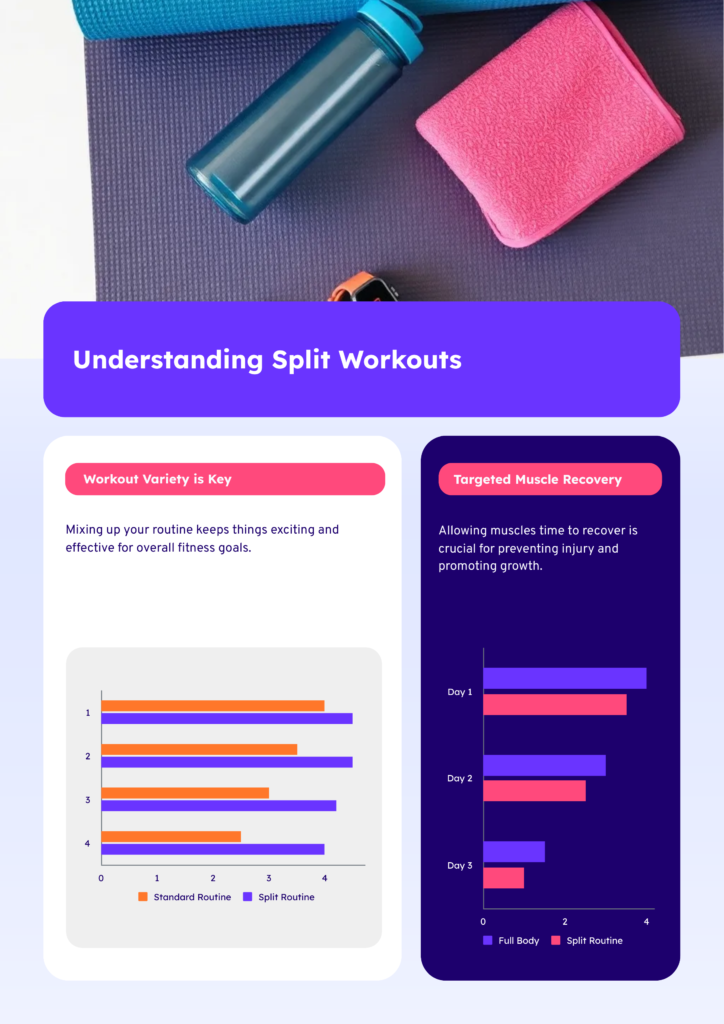
Here is a simple example of how a weekly split might look for beginners:
Upper/Lower Split: Ideal for Strength and Balance
The upper/lower split workout is an excellent choice for many intermediate-to-advanced weightlifters. This split isolates upper-body muscles on certain days and lower-body muscles on others, allowing you to optimize strength gains across all muscle groups while decreasing the risk of overtraining. (Hall, 2026) Because you’re not working the same muscles on consecutive days, you can increase intensity and still recover adequately. This routine is especially effective for those looking to balance workload and maximize progress. (Ramos-Campo et al., 2024, pp. 1330-1340)
However, upper/lower splits can also be a good option for beginners, especially those who can commit to going to the gym at least three or four times per week. Beginners may want to start with fewer exercises per muscle group and use lighter weights while they learn proper form. As your experience and confidence grow, you can add exercises or increase intensity within the upper/lower split structure. This makes it a flexible routine for all levels.

Wednesday: Lower body
Friday: Upper body
Push/Pull/Legs Split
Monday: Push (chest, shoulders, triceps)
Wednesday: Pull (back, biceps)
Friday: Legs
This sample schedule can help you visualize how to organize your workouts during the week and stay consistent.
Split training is different from full-body routines, which are common for many beginners. In a full-body workout, you train all the major muscle groups in a single session. Split routines, on the other hand, divide your workouts so that each session focuses on specific muscle groups. This method can help you create a better-balanced and organized workout plan. You can choose to focus on your lower body, upper body, or both, depending on your goals.
Workout splits provide variety in exercises, help you progress, and allow a balanced schedule with recovery and rest for your muscles. If you are a beginner, choose a split based on how many days you can commit to training each week and what goals you have. For example, if you have three days available, a full-body split might work best. If you can work out four or five days, try an upper/lower split or the push/pull/legs routine. Think about whether you want to build overall strength, target specific muscle groups, or just stay active.
Remember, it is completely normal to experiment and adjust your routine as you figure out what works best for you. Consistency is much more important than having a perfect plan from the start, so do not worry if things change along the way. As you gain more experience, you can change your split to match your progress. Finding the correct split comes naturally since everybody is different. The results will show after following the routine and deciding which suits you best.

Common mistakes when choosing a workout split`
Choosing the Right Training Routine for Your Experience Level and Schedule.
High-frequency routines, such as “The Bro Split,” isolate one or two muscle groups per day and require training five or six days a week, along with a consistent schedule, diet, and adequate rest. (Split Workout Schedule: What To Know and Examples, 2025) The “Bro Split” refers to a routine where each workout day focuses on a single muscle group, such as chest day, back day, shoulder day, leg day, and arm day.
While this approach is popular among bodybuilders, it is often not suitable for beginners. The Bro Split demands a significant time commitment and can make it difficult for beginners to recover fully between sessions, as your muscles may not be accustomed to frequent, intense workouts. Without proper recovery, there is also an increased risk of injury or exhaustion. Beginners are usually better served by routines that allow for more recovery and less frequent training sessions. (Bro Split: Pros, Cons & Complete Guide, 2026) Avoid lifting too heavy too soon. Always assess your experience level and body type before choosing a routine.
Overlooking Your Time and Commitments
- The Mistake: Choosing a split routine that requires more gym days than you can realistically manage often results in skipped workouts and neglected muscle groups. To avoid this, honestly assess how many days you can commit each week before selecting a split. It’s better to start with a reasonable routine and be consistent than to overcommit and fall short. Adjust your split to fit your schedule, making sure all muscle groups get adequate attention and recovery.
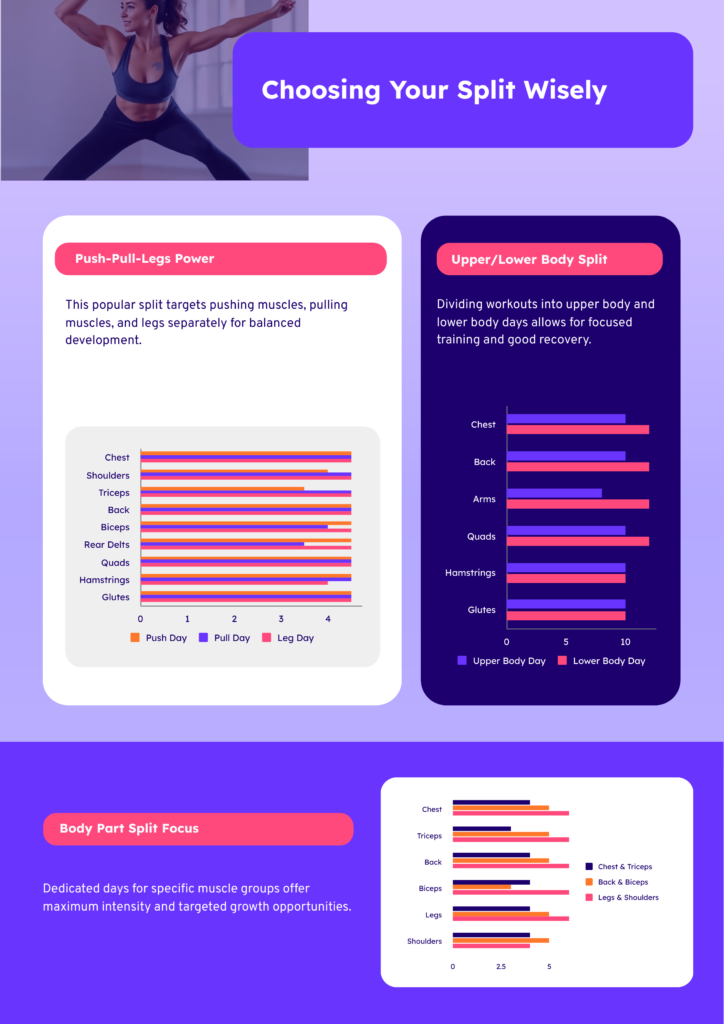
How to Choose a Split Workout Plan
Now that you understand split routines and their benefits, let’s create a workout plan customized to your goals, schedule, and availability. This approach will help you build the body you want while staying consistent.
Here is a simple step-by-step example:
Step 1: Set Your Goal
Example: You want to build muscle and get stronger.
Step 2: Choose How Many Days You Can Train
Example: You have three days a week to go to the gym.
Step 3: Pick a Suitable Split
With three days, a full-body or push/pull/legs split works well.
Step 4: Create Your Weekly Plan
Example Plan:
– Monday: Push (chest, shoulders, triceps)
– Wednesday: Pull (back, biceps)
– Friday: Legs
Step 5: Adjust as Needed
If your schedule changes or you want to try new exercises, swap days or experiment with different splits until you find what fits you best. It can be very helpful to keep a simple workout log or journal for tracking your workouts, how you feel during sessions, and any progress you notice. Tracking your exercises and results helps you see improvements over time and keeps you motivated as you adjust your routine. Remember, consistency matters most, and you can always fine-tune your routine over time.
Factors to Consider Before Choosing a Workout Split
Step 1: Selecting Your Fitness Goals
- Muscle Growth
- Fat Loss
- Strength Training
- General Fitness
Step 2 : Training Experience Level
- Beginner
- Intermediate
- Advanced
- Pro
Step 3 : Schedule and Availability (Weekly)
Step 4 : Post-Recovery and Age
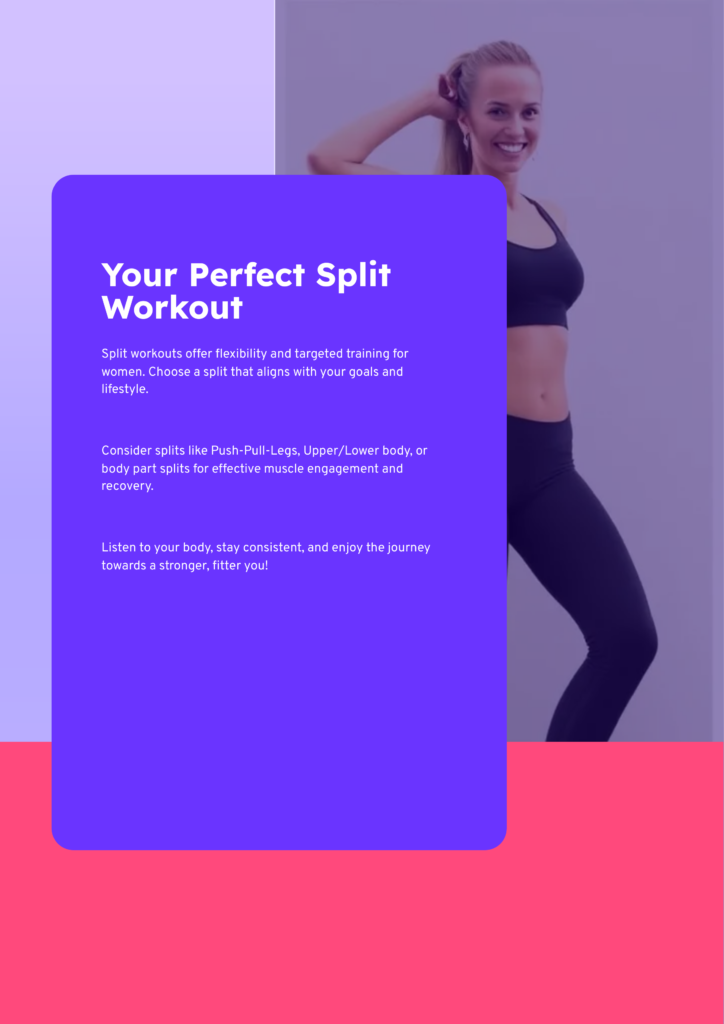
3 Workout Split Routines For Women
While it is common for women to focus more on the lower body—such as glutes, legs, and back—and for men to commonly target shoulders, arms, and chest, these are simply general trends and not requirements. (Uffelen et al., 2017) Anyone can train any muscle group based on their own goals and preferences. You are free to choose which areas you want to focus on, regardless of gender norms.
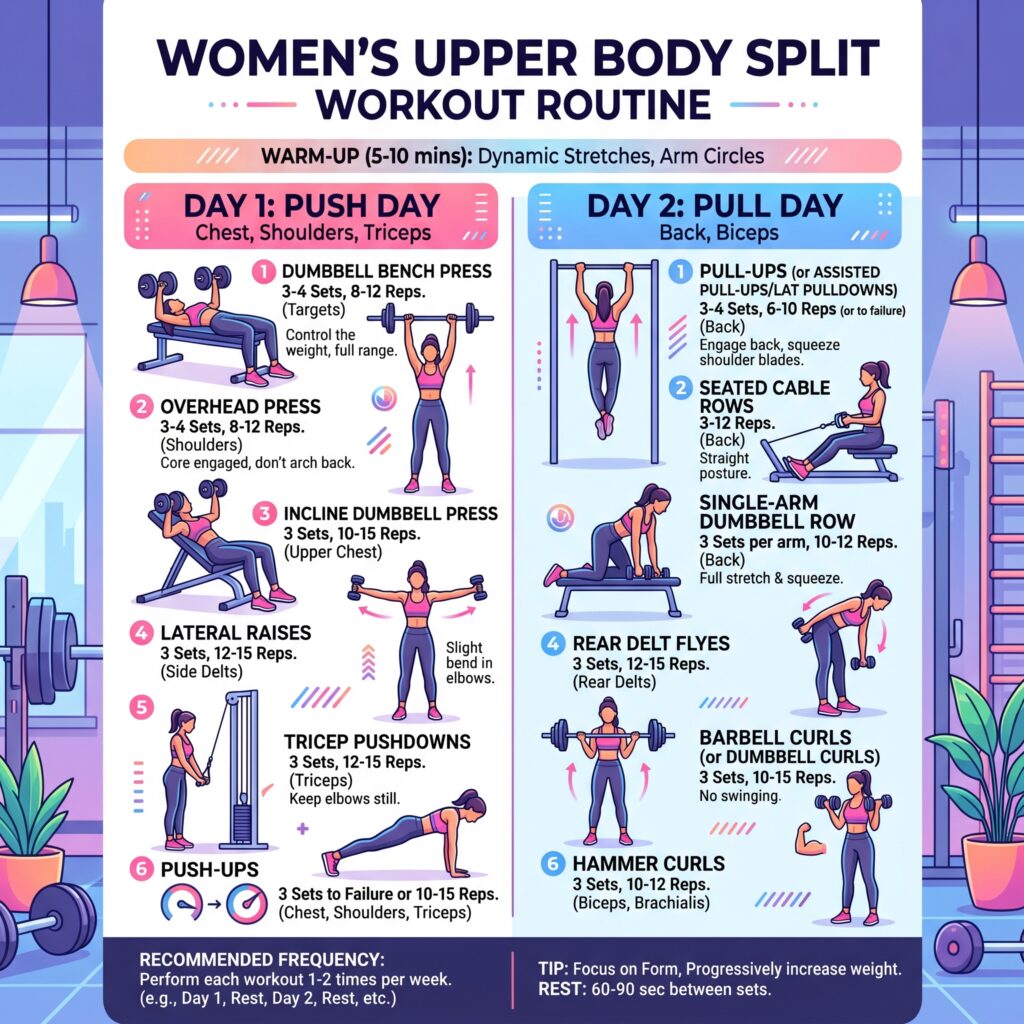
An upper/lower split routine is highly effective for many intermediate and advanced lifters. This approach separates upper-body and lower-body training into different days, helping you boost strength in all muscle groups while decreasing the risk of overtraining. Because you’re not working the same muscle groups back-to-back, you can safely push the intensity of each session. (Ramos-Campo et al., 2024, pp. 1330-1340)
Full-Body Workout Split for Women
A full-body workout split is a highly efficient routine for women trying to gain strength, sculpt their muscles, reduce body fat, and increase overall fitness. (Pedersen et al., 2022) Instead of concentrating on a single muscle group per session like traditional splits, each full-body workout targets all major muscle groups. This makes it a perfect option for beginners and women with limited time, as it delivers results with just 2–4 training sessions each week. (Upper Lower Split: The Complete 4-Day Training Guide, 2025)
Who Ought to Follow a Full-Body Workout Split?
This training style is ideal for:
- Beginners
- Women over 40
- Busy professionals
- Mothers with limited gym time
- Women focused on fat loss.
- Anyone returning after a fitness break.
How Many Days Per Week Should You Train?
2 Days Per Week
Best for:
- Beginners
- Women with very busy schedules
3 Days Per Week
Best for:
- General fitness
- Strength building
- Fat loss
4 Days Per Week
Best for:
- Intermediate exercisers
- Muscle growth and toning
Upper-Lower Split for Women
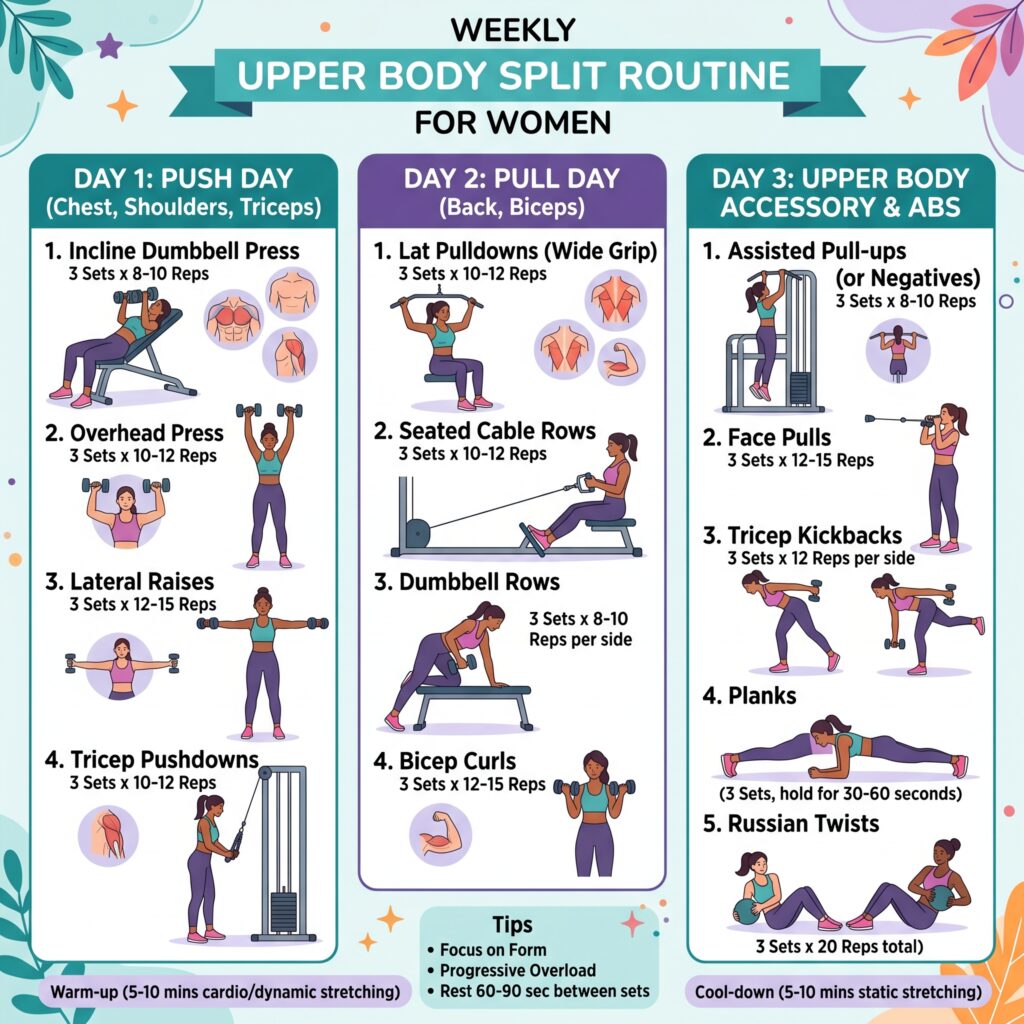
An Upper-Lower Split is a workout routine that divides training days into:
- Upper Body Days – chest, back, shoulders, biceps, and triceps
- Lower Body Days – glutes, quads, hamstrings, calves, and core
This split is ideal for women who want to build muscle, increase strength, improve body composition, and maintain workout consistency.
Benefits of an Upper-Lower Split
- Trains each muscle group twice per week
- Provides enough recovery time between workouts
- Supports muscle growth and fat loss
- Suitable for beginners and intermediate lifters
- Easy to adjust for 4-day or 5-day schedules
Weekly Schedule Example
| Monday | Upper Body |
| Tuesday | Lower Body |
| Wednesday | Rest or Light Cardio |
| Thursday | Upper Body |
| Friday | Lower Body |
| Saturday | Walking, Yoga, or Mobility |
| Sunday | Rest |
Push Pull Legs (PPL) Split for Women
The Push Pull Legs (PPL) Split is a workout system that divides your training into three types of movement patterns:
Push Day: Works the chest, shoulders, and triceps
Pull Day: Emphasizes the back, biceps, and rear shoulders.
Leg Day: Focuses on quads, hamstrings, glutes, and calves
This structure is popular because it effectively targets all major muscle groups while providing enough recovery between sessions. Studies suggest that training each muscle group approximately twice a week can boost muscle and strength gains.
Who Should Try a PPL Split?
The PPL routine is ideal for women who:
– Want to gain lean muscle and strength
– Can train 4–6 days per week
– Have at least several months of resistance training experience
– Want to emphasize glute and lower body development
If you’re a beginner limited to 2–3 workouts per week, you may benefit more from a full-body routine.
Sample 5-Day PPL Split for Women
Monday: Push
Tuesday: Pull
Wednesday: Legs
Thursday: Rest
Friday: Push
Saturday: Pull
Sunday: Rest
Start the following week with Leg day to keep muscle group frequency balanced.
Key Benefits of the PPL Split for Women
– Promotes lean muscle development and strength
– Effectively sculpts glutes and legs
– Allows higher training volume without causing excessive fatigue
– Easily customized for muscle gain or fat loss goals
– Provides enough recovery time between muscle groups
Tips for Success on the PPL Split
– Try to reach 8,000–10,000 steps each day
– Consume 1.6–2.2 grams of protein per kilogram of body weight
– Increase the weights or repetitions gradually over time
– Get 7–9 hours of quality sleep each night
– Stick with your routine for a minimum of 8–12 weeks before making changes

For women aiming to build muscle, increase strength, and improve body composition, following a 5- or 6-day PPL split with added glute emphasis is one of the most effective training strategies available.
Body Part Split (Bro Split) for Women
A Body Part Split—or Bro Split—involves dedicating each workout session to a single muscle group. This method ensures that every muscle gets focused work and ample time to recover before being trained again.
Though this approach has long been favored by bodybuilders, women can benefit from it, too. It’s effective for building muscle, enhancing body composition, and targeting specific areas like the glutes, shoulders, or back.
Example Weekly Schedule
Monday | Legs & Glutes |
| Tuesday | Back |
| Wednesday | Chest |
| Thursday | Shoulders |
| Friday | Arms & Core |
| Saturday | Cardio or Active Recovery |
| Sunday | Rest |
References
Hall, D. (2026). Upper Lower Split: Complete Guide and Sample Program. Mesostrength. https://mesostrength.com/blog/upper-lower-split
Ramos-Campo, D. J., Benito-Peinado, P. J., Andreu-Caravaca, L., Rojo-Tirado, M. A. & Rubio-Arias, J. Á. (2024). Efficacy of Split Versus Full-Body Resistance Training on Strength and Muscle Growth: A Systematic Review With Meta-Analysis. Journal of Strength and Conditioning Research 38(7), pp. 1330-1340. https://doi.org/10.1519/JSC.0000000000004774
(2025). Split Workout Schedule: What To Know and Examples. Healthline. https://www.healthline.com/health/fitness/split-workout-schedule
(2026). Bro Split: Pros, Cons & Complete Guide. TTrening. https://ttrening.com/learn/articles/bro-split-pros-cons
Uffelen, J. G., Khan, A. & Burton, N. W. (2017). Gender differences in physical activity motivators and context preferences: a population-based study in people in their sixties. BMC Public Health 17. https://doi.org/10.1186/s12889-017-4540-0
Ramos-Campo, D. J., Benito-Peinado, P. J., Andreu-Caravaca, L., Rojo-Tirado, M. A. & Rubio-Arias, J. Á. (2024). Efficacy of Split Versus Full-Body Resistance Training on Strength and Muscle Growth: A Systematic Review With Meta-Analysis. Journal of Strength and Conditioning Research 38(7), pp. 1330-1340. https://doi.org/10.1519/JSC.0000000000004774
Pedersen, H., Fimland, M. S., Schoenfeld, B. J., Iversen, V. M., Cumming, K. T., Jensen, S., Saeterbakken, A. H. & Andersen, V. (2022). A randomized trial on the efficacy of split-body versus full-body resistance training in non-resistance-trained women. BMC Sports Science 14. https://doi.org/10.1186/s13102-022-00481-7
(2025). Upper Lower Split: The Complete 4-Day Training Guide. Arvo. https://arvo.guru/resources/upper-lower-split